There’s a quiet gap in most workplace safety strategies. Companies invest heavily in fire drills, ergonomic assessments, and mental health days. But ask how many employees on any given shift are certified to respond to a cardiac arrest or a severe allergic reaction, and the answer is often silence.
That gap has consequences. And closing it starts with first aid training Ottawa — and the growing recognition among forward-thinking leaders that certified preparedness isn’t just a legal requirement. It’s a statement about organizational values.
What Does Workplace First Aid Law Actually Require?
In Ontario, workplace first aid requirements are governed by the Occupational Health and Safety Act (OHSA) and enforced through the Workplace Safety and Insurance Board (WSIB). Employers are obligated to maintain a minimum number of trained first aiders on site based on workforce size and the nature of the work being performed.
The specifics matter. A low-hazard office with fewer than five employees during any shift has different obligations than a construction site or a manufacturing floor. But here’s what the regulations don’t say: that meeting the minimum is enough.
Minimum compliance keeps you legally protected. It doesn’t keep your people safe.
Why Minimum Compliance Leaves Teams Exposed
Think about what “one certified first aider per shift” actually looks like on a Monday morning when that person is on vacation, running late, or handling something else across the building. The certificate is current. The coverage isn’t.
Progressive employers are moving beyond the math of compliance and thinking about genuine readiness. That means:
- Cross-training multiple team members so first aid coverage doesn’t collapse when one person is absent
- Refreshing certifications proactively rather than scrambling when renewal deadlines pass
- Including first aid orientation as part of onboarding for new hires at all levels
This approach costs relatively little. The return — measured in outcomes that are, frankly, uncountable — is considerable.
What Does Standard First Aid Certification Actually Cover?
The standard CPR/AED Level C and Standard First Aid certification is more comprehensive than most people realize going in. It typically covers:
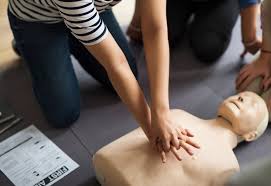
- Cardiac arrest response — adult, child, and infant CPR with correct compression depth and rate
- AED operation — deploying an automated external defibrillator in the critical window before paramedics arrive
- Choking response — abdominal thrusts and back blows for conscious patients
- Bleeding control and wound management — applying direct pressure, recognizing signs of shock
- Anaphylaxis recognition and epipen protocols — identifying severe allergic reactions and supporting epinephrine administration
- Fracture and spinal injury management — stabilization without causing further harm
- Stroke and diabetic emergency recognition — reading symptoms and making the 9-1-1 call with useful information
A full Standard First Aid course typically runs over two days. Blended learning options — online theory completed in advance followed by a single in-person skills day — have made it considerably easier to integrate training into busy team schedules without pulling people out of operations for extended periods.
The Leadership Angle Most Organizations Miss
There’s a cultural dimension to first aid training that rarely shows up in risk management discussions, but that experienced leaders recognize immediately.
When an organization invests in certifying staff — not just the bare legal minimum, but a meaningful proportion of the workforce — it communicates something. It says: we take your safety seriously enough to train the people around you. That message lands differently than a poster on the lunchroom wall.
Teams with trained first aiders report higher confidence in their employers’ safety commitments. That confidence feeds into engagement, retention, and the kind of psychological safety that actually moves performance metrics. Not through a single mechanism, but through the cumulative effect of people feeling genuinely looked after.
There’s also the less comfortable conversation: liability. An employer who can demonstrate that training was current, coverage was meaningful, and response was prompt is in a significantly different legal and insurance position than one who cannot. WSIB investigations following a workplace incident will ask exactly these questions.
Who Should Prioritize Workplace First Aid Certification?
The honest answer is: every employer. But certain sectors carry heightened urgency:
Construction and trades. Fall injuries, lacerations, and crush incidents demand immediate response before emergency services arrive. Time to intervention is the variable that most determines outcome.
Healthcare and social services. Ironically, not all healthcare-adjacent workers are certified first aiders. Staff in residential care, social work, and community health settings often have significant gaps.
Education. Teachers and education support workers routinely encounter medical emergencies — seizures, allergic reactions, cardiac events — with limited training beyond a two-hour refresher from years ago.
Offices and corporate environments. Cardiac arrest doesn’t discriminate by industry. The average response time for paramedics in a major Canadian city is six to nine minutes. A trained colleague can bridge that gap — or not.
How to Build a First Aid Culture Without Disrupting Operations
Practical steps for managers who want to act on this:
- Audit current certifications. Who is trained, at what level, and when do certifications expire? Build a renewal calendar.
- Identify coverage gaps by shift. Don’t just count certified staff — map them against actual shift patterns and locations.
- Set a target ratio. Many safety consultants recommend at least 10–15% of staff certified, above whatever the regulatory floor requires.
- Use blended learning. Online theory modules allow staff to complete coursework independently; the in-person skills day is then focused, efficient, and minimally disruptive.
- Normalize recertification. Treat it like a fire drill — scheduled, expected, and never optional.
Coast2Coast First Aid & Aquatics is a Canadian Red Cross and Heart & Stroke Authorized Training Partner offering Standard First Aid, CPR/AED Level C, and BLS certifications through a blended learning model. Corporate group bookings and flexible scheduling are available to accommodate teams without pulling staff from operations for extended periods.
If you are looking for workplace first aid or CPR certification training near Rideau Street, King Edward Avenue, Sandy Hill, or the University of Ottawa area, you may reach out to Coast2Coast First Aid & Aquatics in that area.
FAQs
Q: How many trained first aiders does Ontario law require per workplace? A: Under Ontario’s OHSA regulations, requirements vary based on workforce size and hazard level. Low-hazard workplaces with fewer than five employees per shift may not require a designated first aider, while larger or higher-risk environments have more specific requirements. Employers should review the WSIB’s first aid regulation schedules and consult with a safety officer to confirm what applies to their workplace.
Q: Does Standard First Aid certification expire, and how often does it need to be renewed? A: Yes — Standard First Aid certifications issued by Canadian Red Cross and Heart & Stroke-affiliated providers are valid for three years. CPR components within the certification typically require renewal every two to three years. Employers should track expiry dates proactively to avoid coverage gaps.
Q: What is the difference between Standard First Aid and Emergency First Aid? A: Emergency First Aid is a shorter, single-day course covering critical life-threatening scenarios — cardiac arrest, choking, severe bleeding. Standard First Aid is more comprehensive, covering a broader range of medical emergencies over approximately two days. For most workplace compliance purposes under Ontario OHSA, Standard First Aid is the appropriate credential.
Q: Can a whole team be certified at once, or does training need to happen individually? A: Group corporate training is a common and efficient option. Many providers offer on-site or facility-based group sessions that can certify multiple staff members simultaneously, reducing per-person cost and minimizing scheduling disruption across departments.
Q: What is BLS certification, and which roles need it? A: Basic Life Support (BLS) is a higher-level certification designed for healthcare providers — nurses, paramedics, dental professionals, and other regulated health workers. It covers two-rescuer CPR, advanced airway management basics, and clinical scenario practice. Most corporate and general workplace roles require CPR/AED Level C or Standard First Aid, not BLS.